


Unhurried Childhood
The Primary years at Joy stands on the philosophy of unhurried childhood. The joy of childhood, the joy of learning - with wonder and awe filled eyes. At the primary level, with Chrysalis being our knowledge partner we provide a connected learning experience, wherein the learners always have freedom to question. Chrysalis is leading a fundamental reform in school education through its transformational programme, Thinkroom, which challenges mediocre practices in the Indian educational ecosystem. The teaching concepts we follow brings lessons alive through vivid projects and absorbing activities that heighten student curiosity and engage them both intellectually and emotionally. The most important aspect of our primary learning is to make each and every child a self-directed learner. We encourage our primary-level kids to learn using various modes like hands-on learning, peer learning, assimilating feedback to improve, and independent research which encompasses self-directed learning. Our enthusiastic and dedicated teachers capture students interests and are motivated to seek answers to questions, plan investigations and explore ideas.

The Consciousness of the child in the Primary Years
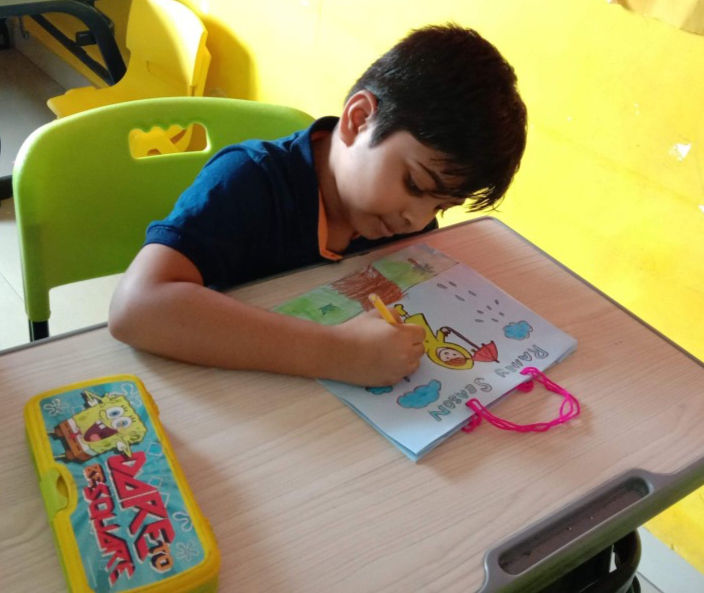
In first grade, the formal introduction to writing and reading is brought in a lively pictorial way through fairy tales, folktales and nature stories. Reading evolves throughout the year, and the writing of familiar poems and verses support this process. Children are soon able to read and write words and simple sentences. Number work is begun, again with pictures, rhymes and stories and the four processes are introduced. A start is made on learning times tables by heart. One second language – Telugu/ Hindi is introduced. There is more rigour and structure to speech, movement and sports. As part of the artistic curriculum, children have art and craft classes.
As the children move into second grade, they are ready for more challenges and a quicker pace of learning. Word families, phonics, digraphs, basic vowel patterns, and early grammar concepts are introduced and worked with extensively throughout the year. Beautiful handwriting is encouraged and practiced regularly. In Math, mental math techniques, movement, and other methods are applied regularly to enhance the curriculum. The wonder of number patterns is expanded through geometric forms and patterns as well. Nature studies are done with stories and experiencing the outdoors and connecting to the surroundings that they belong to. Speech, movement and sports are done more rhythmically. New handwork and clay modelling projects are introduced through art and craft.
The third grade is often called the turning point of childhood. At this point in development, children are transitioning out of the dreamy state of their early years and entering the serious world as they never have before. Creative writing, reading every day and grammar concepts become more specific and clearer. Math lesson becomes more practical, concepts of time and money, linear measurement are introduced. Through Environmental studies, the concepts and experiential learning concepts allow the child to engage in practical and meaningful work actively. Speech exercises continue regularly, and third graders often perform a play that is longer and tougher, and serious in its subject. Painting, form drawing and handwork are designed to challenge the growing minds.
In fourth grade, the children are emerging from the nine-year change and now are standing independently in the world. Curiosity grows, and a desire to learn more about the world in which one lives deepens as well. The Main Lessons provides more opportunities for more independent work. They are introduced to local geography, local history, and beginning with the Norse myths. In English, grammar work covers the tenses and parts of speech. Second language skills are further developed with grammar and composition writing, including verb tenses, spelling, punctuation, and use of the dictionary. Class readers are assigned to cushion and kick start the habit of reading. In math’s, fractions are introduced, using all four processes; measurements, area work is continued. In sciences, the form and functions of humans and animals are introduced. Speech, poetry, recitation becomes more advanced. Painting and handwork lessons become a bit more complicated.
The fifth grade is the golden year of childhood, a keystone year for the growing pre-adolescent. It is a time where the child has an inner balance, strength and confidence before the turbulence of adolescence arrives. Main Lessons includes- early civilizations of India. Writing skills are further developed and is more self -generated. Grammar lessons become more complex and concrete and mastery in spellings is emphasized. Reading books of different genres is encouraged. In math, fifth graders focus on the study of decimals and continue to reinforce and expand upon their necessary skills learned in years prior. Fractions, mixed numbers, conversion of decimals to fractions and fractions to decimals is mastered. In sciences, it is the study of world around which includes the exploration, experiential and many more. Speech, writing and form drawing more complex as the child prepares to enter Middle School.
Co-scholastic Details
Exploring interests beyond academics
We understand that education is a multifaceted journey that encompasses more than just academic excellence. Co-scholastic activities play a crucial role in shaping well-rounded individuals by providing students with opportunities to explore their interests, develop essential life skills, and foster a sense of community. We believe that these activities are integral to nurturing the holistic development of each child, preparing them for success both inside and outside the classroom.